The Navy Film Recorder

Gallery opened 23 Sept 2024

Updated: 29 Sept 2024

Yet more on the Navy Film Recorder added

Audio cut into cellulose film

Back to Home PageBack to The Museum

Before magnetic recording on wire or tape was sufficently developed for widespread use, recordings were made on other media. The following systems are already in the Museum:

This machine takes recording with a stylus that cuts grooves into film to a new level- 16-track recording!
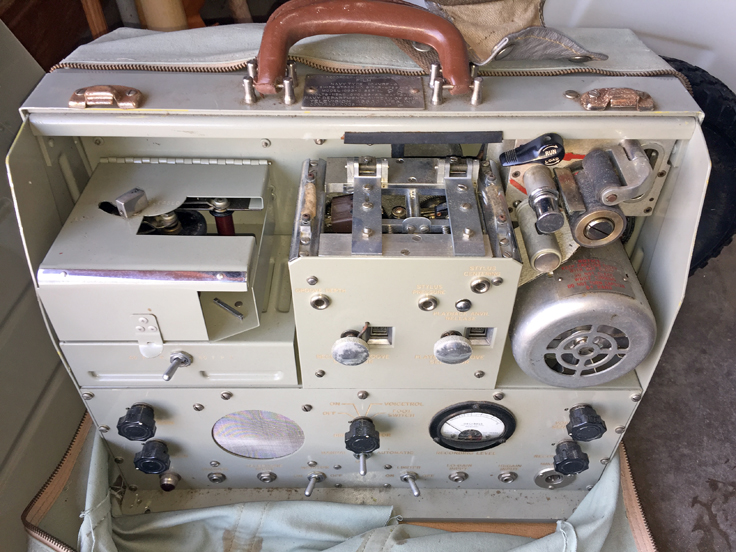
Left: US Navy Type IC-VRF-6 Film recorder: 1950s

This sound recorder was used in the mid 1950's to record communications and could record 16 tracks of audio for 2 hours. It actually seems highly unlikely that it could record more than one track at a time; that would require multiple valve amplifiers and the machine is simply not big enough to hold them.

The machine recorded audio using a sapphire needle to cut grooves on 35mm cellulose acetate film.

The film speed was 40 feet per minute. (8 inches per second) Audio power output was quoted as 5 Watts and the frequency response as +/-3 dB 300 to 4500 Hz, ref 1000 Hz; useful for telephone signals but not much else. It was powered by a standard 115V AC supply.

Googling to find further information has not been rewarding. I would be very glad to hear from anyone with more information.

Left: US Navy Type IC-VRF-6 Film recorder: 1950s

This shows the upper right part of the control panel, and it eliminates all doubt as to the mode of operation, as there are preset controls labelled 'STYLUS PRESSURE' and 'STYLUS CENTERING'. Below them there is a chrome push-button enigmatically labelled 'PLAYBACK ANVIL RELEASE'.

Below that again is a knurled metal knob labelled 'PLAYBACK GROOVE SELECTOR' and it looks as if the number of the track chosen appears in the little silver window just to the right of the knob. To the left is a similiar knob/window combination labelled 'RECORD GROOVE SELECTOR'. This seems to establish that the machine could only record and play back one track at a time.

Left: US Navy Type IC-VRF-6 Film recorder: 1950s

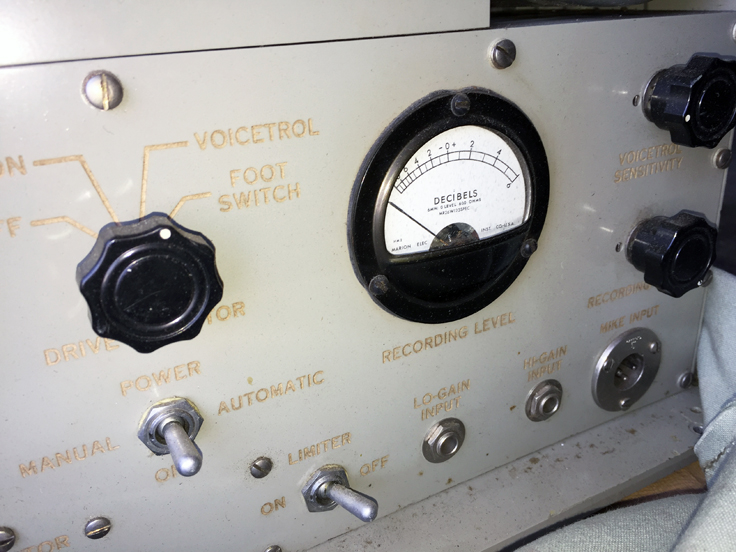
Another part of the control panel. 'Voicetrol' strongly suggests some sort of voice or signal-activated recording facility; this is supported by the black knob on the extreme upper right, labelled 'VOICETROL SENSITIVITY.

At bottom right there is what looks very like an XLR connector, labelled 'MIKE INPUT'. This is very likely, as XLR connectors were introduced in the 1950's. This is a male XLR; in modern usage inputs are female.

Left: US Navy Type IC-VRF-6 Film recorder: 1950s

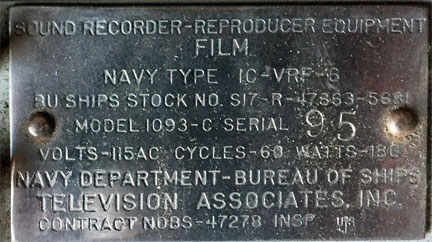
The machine appears to have been made by a company called Television Associates Inc, judging by this nameplate. The company is unknown to Google as an audio business, but bizarrely there is a trucking company of that exact name.

Back to Home PageBack to The Museum EntranceTop of this page