This page deals with a power source that is now long gone- animal power. In earier times horses and oxen walked in circles to grind corn, and a donkey in a giant hamster-wheel was used to draw water from the wells in Dover and Carisbrooke castles. Dog-power, however, has always been limited in its application by the limited horsepower of the average dog.
The best-known use of dog-power is probably the dog-sled for travel over ice and snow. This gallery of the museum focuses on the more unusual uses of dogs.

TURNSPIT DOGS
Dogs were used in wheels to turn roasting spits in Britain, coming into use in the 1500's. There was even a special breed, called not unreasonably "the turnspit" for the purpose. Turnspit dogs were first classified as a breed in 1576 by Johannes Caius, royal physician to Elizabeth I at the time, in his book "Of Englishe Dogges". (He also found time to refound Gonville & Caius College, Cambridge in 1557) They were known by a number of alternate names including the kitchen dog and the Vernepator Cur, which is Latin for “the dog that turns the wheel”, and is about as exact a name as you could ask for. The breed’s scientific name, given by Linnaeus, is canis vertigus, which literally translates to “dizzy dog”. Hilarious.
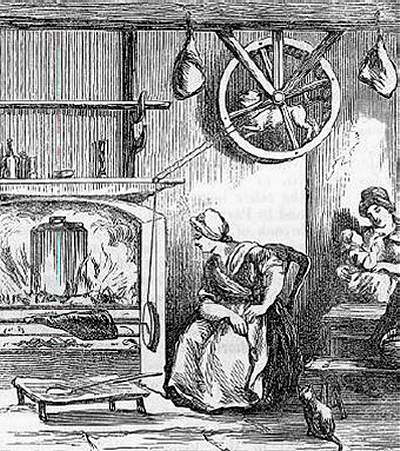 |
| Left: Turnspit and dog-wheel: 1700?
The artist seems to have completely messed up drawing the belt drive system, and this depiction probably should not be relied upon. Here the dog-wheel is geared down to the roast, so the latter rotates more slowly.
According to John George Wood in The Illustrated Natural History (Mammalia) published in 1853, a pair of turnspit dogs were often used to share the work: "The dogs were quite able to appreciate the lapse of time, and, if not relieved from their toils at the proper hour, would leap out of the wheel without orders, and force their companions to take their place, and complete their portion of the daily toil." According to Mr Wood's book, Queen Victoria kept retired turnspit dogs as pets.
Turnspit dogs seem to have fallen out of favour with the introduction of roasting jacks that turned the meat using clockwork, steam, or even a primitive sort of gas-turbine. By the end of the 19th century the breed was officially declared extinct. Intriguingly, it appears that even at the start of the 19th century, people were convinced that the turnspit breed wasn’t going to last. For example, Memoirs of British Quadrupeds by William Bingley, published in 1809, states: "It is now on the decline; and, in the course of another century it will probably be extinct in Great Britain", which describes what actually happened with depressing accuracy.
Note the dog working hard and the cat doing nothing.
|
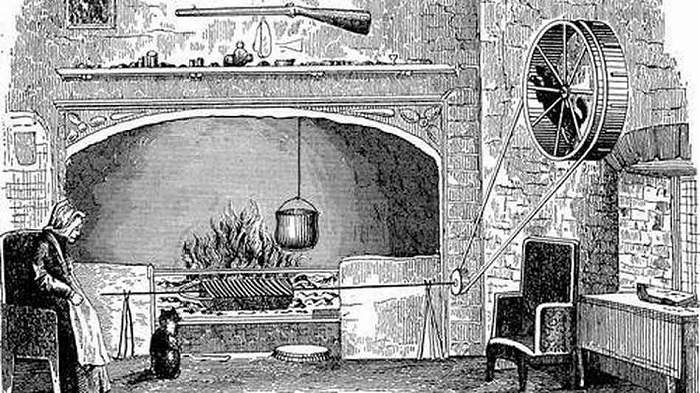 |
| Left: Turnspit and dog-wheel: 1700?
Here the dog-wheel is geared up to the roast, so it would surely have been spinning round at high speed. This seems wrong; probably the artist knew nothing about gearing.
Once again the cat is doing nothing...
|
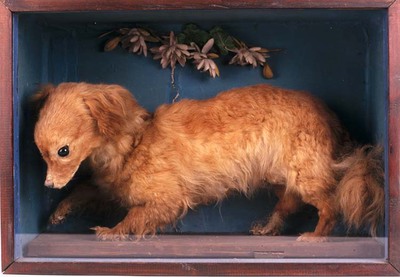 |
| Left: Whiskey the turnspit dog: 1800?
Turnspit dogs seem to have been regarded as lowly creatures (another name used was 'underdog') and no-one seems to have paid them much attention. No photographs are known to exist, but we do have a single stuffed specimen called Whiskey. The date of the stuffing has been lost but is thought to be around 1800.
I find this very sad.
There is not much to give scale in this picture, but judging by the leaves at the back of the case it was a small dog.
|
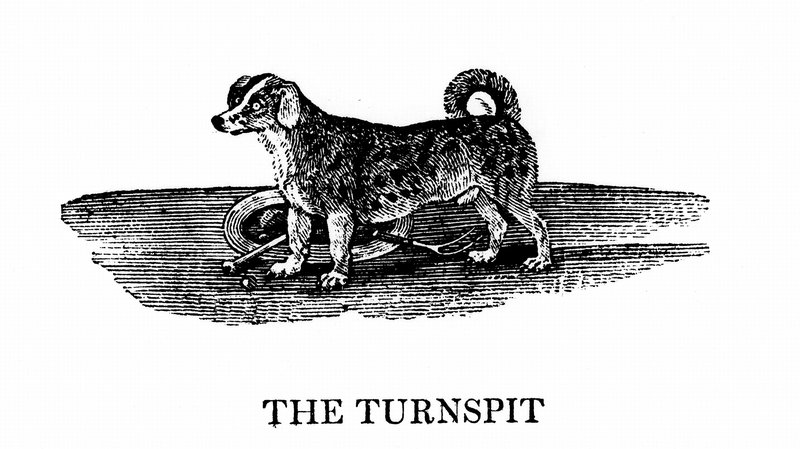 |
| Left: Engraving of a turnspit dog, not liking the look of the future
Assuming that is a normal-sized plate and cutlery, it is clearly quite a small dog. Note old-fashioned two-prong fork.
|
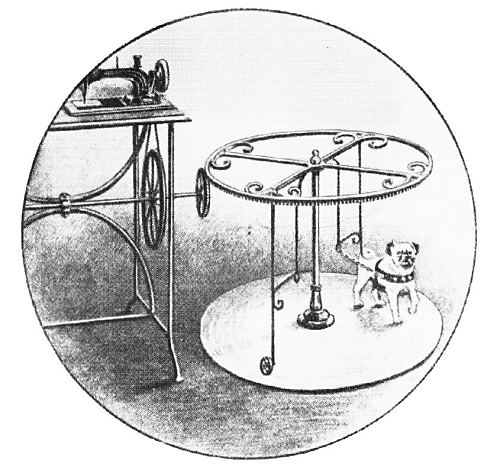
AN ENGLISH DOG-ENGINE: 1874
 |
| Left: English Dog-Engine: 1874
This dog-engine for sewing machine use was patented in England around 1874, but the actual patent has not so far been located.
I suggest this is a sketch of an impractical scheme rather than a drawing of real machinery. The dog-drive vertical shaft appears to be geared up by at least six time to the horizontal shaft, which is geared-up again by possibly eight times by the belt drive to the sewing machine itself. This would mean that Fido would have to exert a considerable torque as he paced round. Since he is shown here apparently as a small pug-dog, he does not appear to have what in a steam locomotive would be called "sufficient adhesive weight" to get the contraption moving. This is no doubt the reason for the disgusted look on his face.
Note that a hitching position for a second dog is provided, which would allow a "balanced drive".
From Patent Applied For by Coppersmith and Lynx. Co-ordination Press 1949.
|
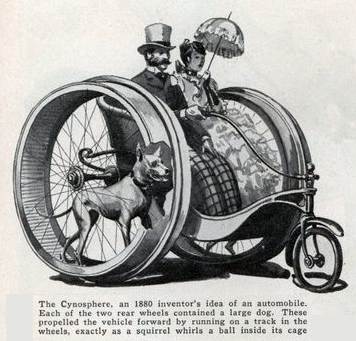
THE CYNOSPHERE: 1880
 |
| Left: The Cynosphere
This is an artist's impression from Popular Science Monthly. It seemed highly unlikely that such a daft vehicle had ever been built... but see the picture below.
From Popular Science Monthly Sept 1933
|
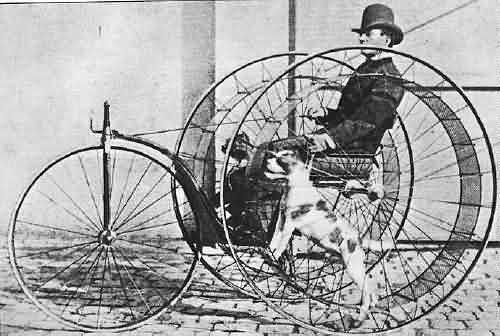 |
| Left: The Real Cynosphere: 1875?
This is the real thing. Apparently it was built in France in 1875, but details are currently lacking.
Personally I think that heavier dogs than those shown would be needed. And how you balance the torque of two dogs I cannot imagine, so steering must have been interesting.
The name "Cynosphere" derives from the Greek word kyôn, "dog", though it's not clear where "sphere" comes in.
Source unknown
|
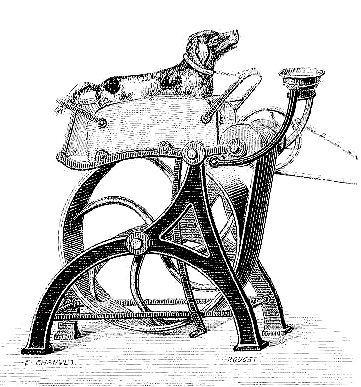
THE RICHARDS DOG-ENGINE: 188?
 |
| Left: The Richards Dog Engine
This machine was originated by a M. Richards of Paris, who employed a large number of sewing-machines to make military uniforms. It could apparently power four heavy sewing machines, working intermittently; I would have thought this would require a pretty heavy and active dog. Unfortunately the engraving gives no scale, so it is hard to guess how big dog and machine were.
The description given is very sketchy, but it seems the dog walked on the wide belt that runs round the large and small rollers. The power is taken off from the small roller, and judging by the angle of the belting running off to the right, is further geared up to drive the sewing machinery. This seems like further evidence of the need for a pretty heavy dog. The Rottweiller would seem to be a possibility; however, the aftermath of the Franco-Prussian war was probably not a good time to introduce German breeds to France.
The dog in the illustration is definitely not a Rottweiller.
From the French journal Nature 188?
|
It is only fair to add that Nature was not hell-bent on exploiting our four-legged friends. They said "This method always arouses grave objections, from the point of view of humanity as well as mechanics." They went on to point out that the sewing-machine work was intermittent, giving the poor dog frequent rests. Note that a bowl of water is thoughtfully provided in front of him; however I cannot rid myself of the suspicion that it might be placed just out of reach to encourage Fido to move forwards.
THE FELDT DOG-ENGINE: 1888
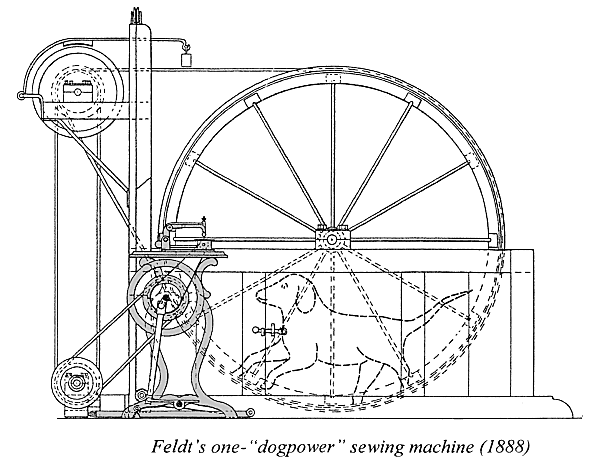 |
| Left: The Feldt Dog Engine: 1888
This dog-engine to drive a sewing machine was patented by Heinrich Feldt of Hamburg.
At the top left there is a brake shoe held down by a weight, which can be lifted by a string attached to the sewing-machine treadle, to control the flow of dog-power. This crude and inefficent approach to speed control has not discouraged Fido, who from his expression remains doggedly optimistic about his job.
From The Middle Ages of the Internal Combustion Engine by Horst O Hardenberg
|
DOG HAULAGE
The use of dogs to pull sledges in ice and snow is commonplace, but they were also used to pull wheeled vehicles.
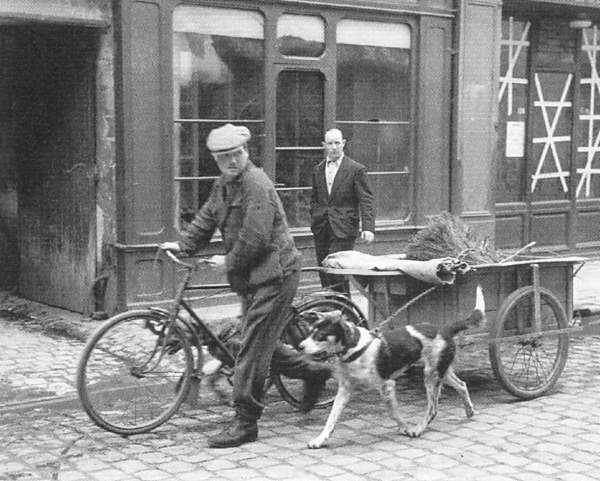 |
| Left: Auxiliary dog-power at Bayeux, 1944
Not strictly a dog-engine, but a nice picture of two dogs lending their efforts to pull a cycle-drawn cart. In occupied France, most motor vehicles had been requisitioned and petrol was virtually unobtainable.
|
Dog carts pulled by two or more dogs were historically used in Belgium and The Netherlands for delivering milk, bread, etc. Dog-drawn carts were prohibited in Britain in the early 1840s on animal welfare grounds.
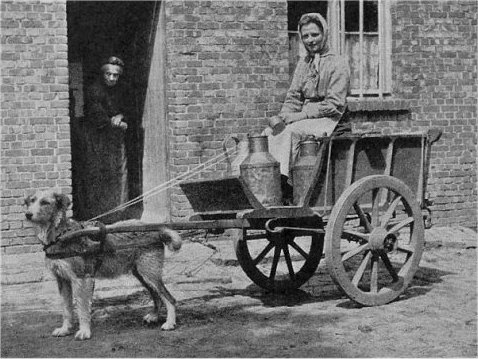 |
| Left: One-dog milk cart in Belgium or Holland
Since our single dog has to pull not only milk but the milklady, the outfit seems a bit underpowered.
At least the milk inspector has not caught up with her. Yet...
|
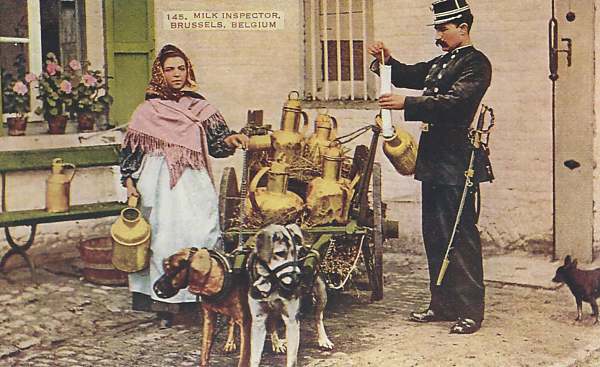 |
| Left: Two-dog milk cart in Brussels, Belgium
A two-dog milk cart in Belgium, with milk inspector at work, apparently testing the milk with a hydrometer to see if it has been watered down. Note the big sword he carries; Belgian milkmaids are clearly not to be trifled with.
Postcards like this were very popular, and many examples can be found on the Internet. Milk inspectors were often included to add interest, and this does not mean (as far as I know) that Belgian milkmaids were a pack of desperate criminals that required intensive policing.
Note small dog at right.
|
 |
| Left: Three-dog milk cart in Belgium: 1900
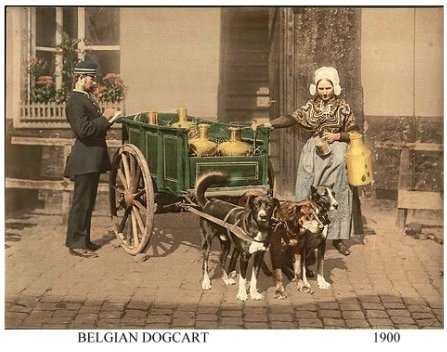
A three-dog milk cart in Belgium in 1900.
Once again, an inspector calls.
|
 |
| Left: Belgium, 1908
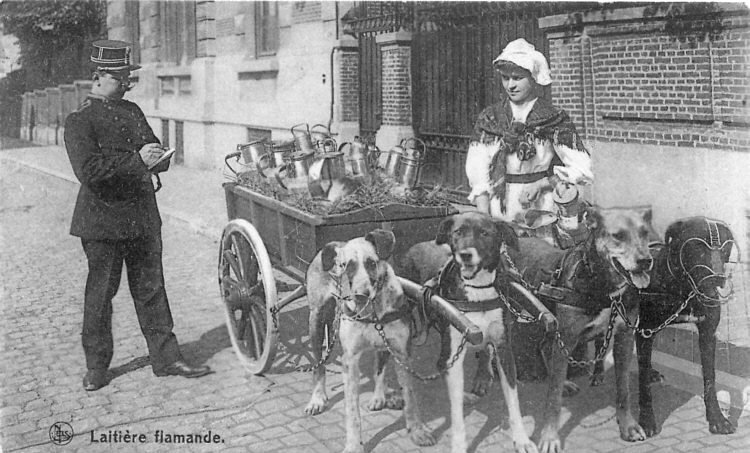
A four-dog milk cart in Flanders, 1908. The official in the hat, armed with a sword, is not handing out a parking-ticket; he is a milk inspector.
The dog on the right seems to be wearing a bizarre muzzle that makes him look like Magneto; Dogneto, perhaps?
|
 |
| Left: Five-dog milk cart in Belgium or Holland
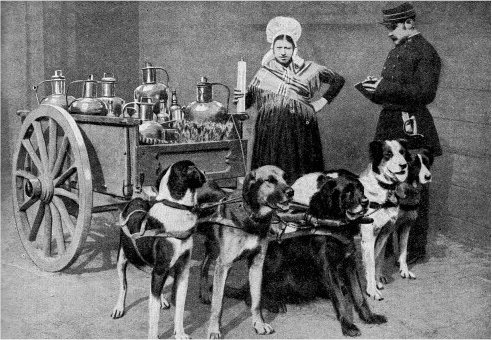
A five-dog milk cart, with the essential milk inspector. The formidable milklady is holding the vertical glass cylinder in whch milk was tested for watering down. This inspector also carries a sword though only the hilt is visible.
A lactometer (or galactometer) is a hydrometer used to test milk. The specific gravity of milk does not give a conclusive indication of its composition since milk contains a variety of substances that are either heavier or lighter than water. Additional tests for fat content are necessary to determine overall composition.
|
In every case the dogs are harnessed in parallel, rather than series; no doubt there was a good reason for this. It has to be said that no six-dog milk carts have so far been found, but the Museum staff are still searching.
Walter E Mason described the purpose-bred Draught Dog in "Dogs of All Nations" (1915):
"This is more or less of a nondescript variety, but he is worthy of a place in the sun [worthy of a mention] by reason of the inestimable service he renders to his master or mistress. Daily he may be seen in Belgium and Holland drawing the carts purveying milk, butter, vegetables and other similar household necessities. He varies in height from about 24 in. to 32 in. and weighs around 100 Ibs. Fawns and brindles are the most common colors. In general appearance he is a cobbily-built strong dog capable of great endurance. Naturally he must be strongly made in back and loins, well boned in legs and with feet well padded. The tail is generally docked to about three inches."
|
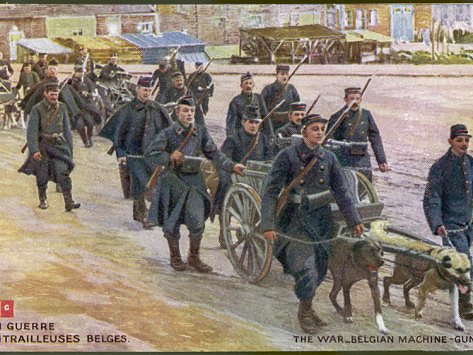 |
| Left: Machine-gun haulage by two dogs in Belgium: 1914-18
The dogs were probably conscripted from the milk-cart dogs, as they were already trained for haulage.
|
In England, things were different. In 1839, the Dog Cart Nuisance Act prohibited the use of cart dogs within 15 miles of London's Charing Cross rail station. The RSPCA regarded dog-haulage as "cruel servitude", but what about draught horses? There appears to have been a fear that overworked dogs were more susceptible rabies. Dog carts were mainly associated with bakers.
Poor households could not afford to keep dogs that couldn't work. Many dogs were abandoned to starve and at least 150,000 were destroyed in the first year of the new legislation. Often children replaced the dogs in pulling the carts. There were no laws against child labour.
DOG-POWER IN GERMANY
Germany seems to have been a fertile field for the use of dog-power.
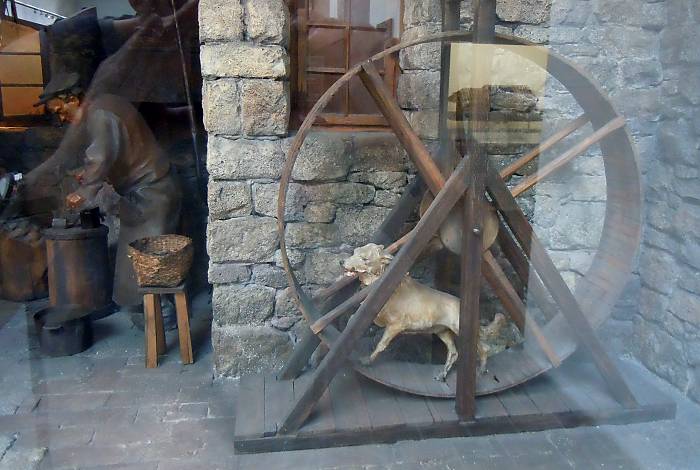 |
| Left: Model of Dog Engine in Deutsch Museum, Munich
This dog-engine is shown in the model as driving a bellows for a small nail-making forge. According to the label, the nail-maker would shout orders to the dog to speed up: "Faster, Wulfi! I need more heat!"
The label further states that such dog-engines were in use by nail-makers up to 1930. This seems extraordinarily late- surely all nails were made by machine much earlier than that? Perhaps some sorts of specialised nails were made by hand in small quantities.
Author's photograph June 2011
|
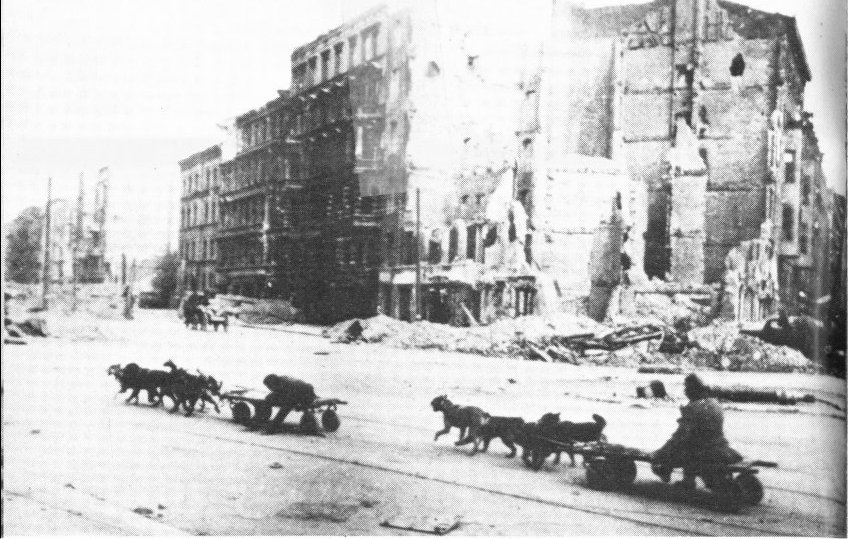 |
| Left: Dog-hauled trolleys: Berlin 1945
During the battle for Berlin, in some cases ammunition was brought up and the wounded evacuated by dog-drawn trolleys.
Source: The Last Battle, Cornelius Ryan, pub Collins 1966
|
THE POOCHMOBILE: USA
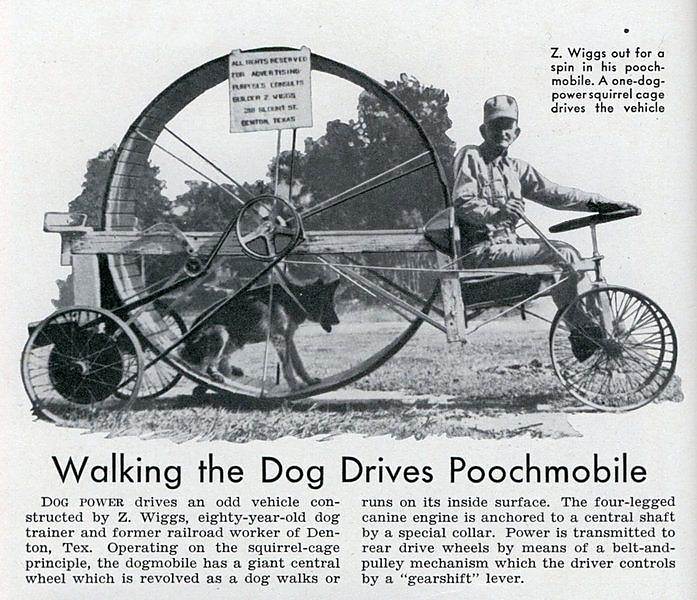 |
| Left: The Poochmobile: 1939
This surprisngly well-engineered vehicle was called the "Poochmobile". It was invented by eighty year-old dog trainer Z. Wiggs of Texas, who is presumably the man at the wheel here. It even appears to be fitted with headlights. (by the driver's right elbow) Note the placard at the top, attempting to raise some advertising revenue.
The dog looks less than enthusiastic.
From Popular Science, Nov 1939
|
GOAT HAULAGE
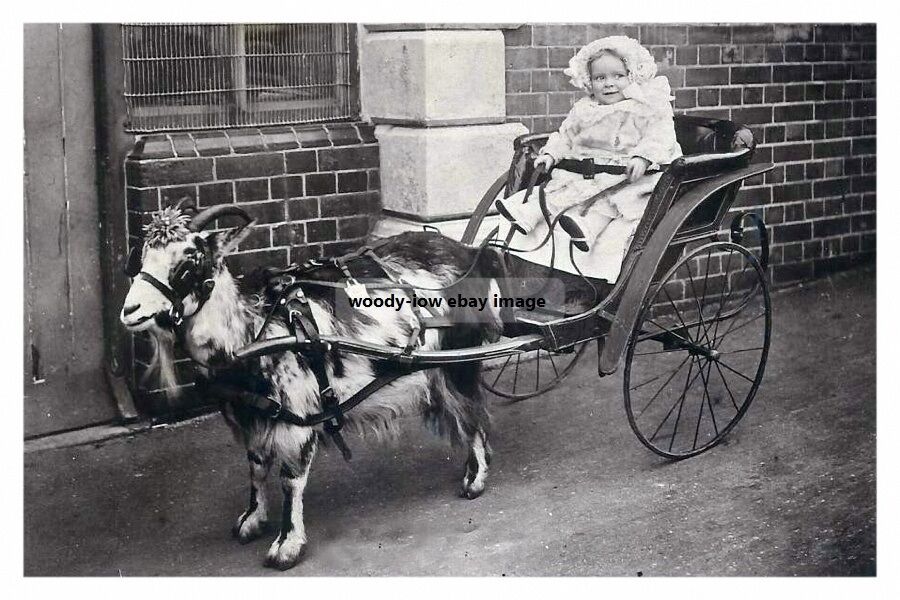 |
| Left: One-goat haulage: date unknown
|
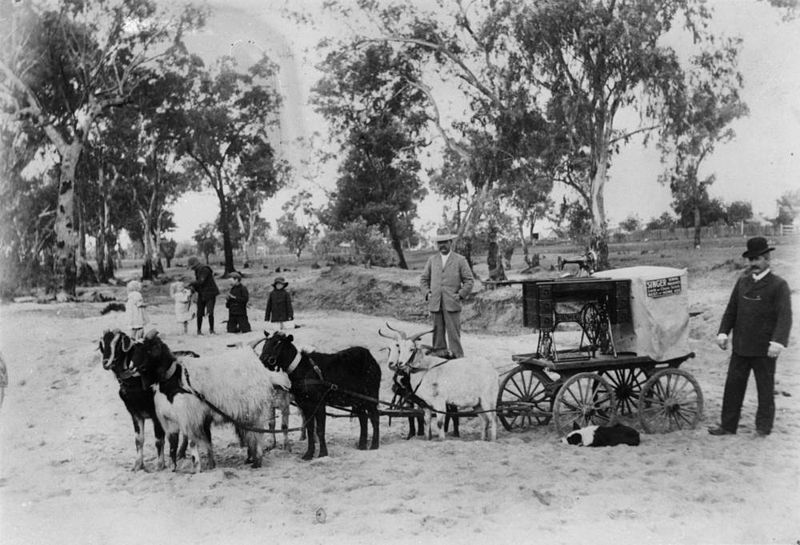 |
| Left: Six-goat haulage: ca 1910
This picture shows a Singer sewing machine mounted on a cart pulled by six goats, possibly as an advertising stunt. There seems to be a dog asleep in front of the cart.
|
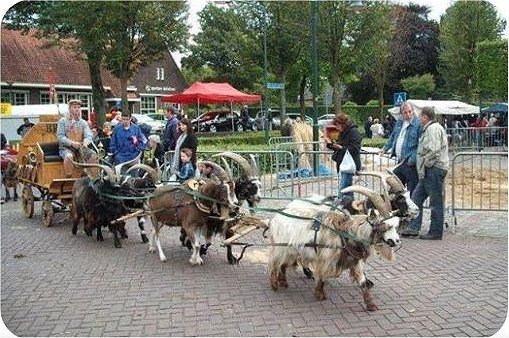 |
| Left: Six-goat haulage
Another cart pulled by six goats, with some very fine horns there.
Location and date unknown.
|
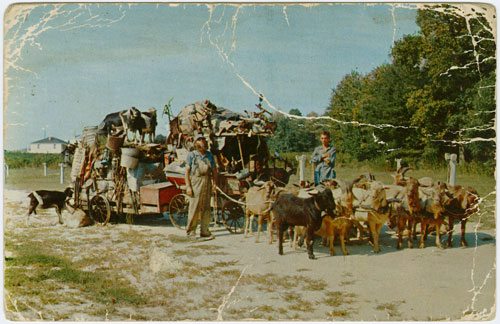 |
| Left: Nine-goat haulage: 1930 to 1987
It is a question as to who has used the most goats to pull a vehicle. Currently a contender is Ches McCartney, also known as The Goat Man. He travelled in a wagon pulled by about nine goats, with a few more following behind to occasionally push the wagon or help with braking on downhill slopes. His travelling goat herd sometimes numbered up to thirty.
Ches McCartney has a Wikipedia page.
|
GOAT-ENGINES IN GERMANY
This picture also comes from the Deutsch Museum in Munich. (Apparently the largest science museum in the world, and having spent a whole day failing to even cover the ground floor, I am entirely prepared to believe it) Goat engines are a new idea to me. Goats are not as docile as dogs and I would have thought that they would not have co-operated. Nonetheless, a bit of research on Google shows that goat treadmills were used in the USA for driving small threshers (very small, surely?) and turning sharpening stones, which I find more plausible.
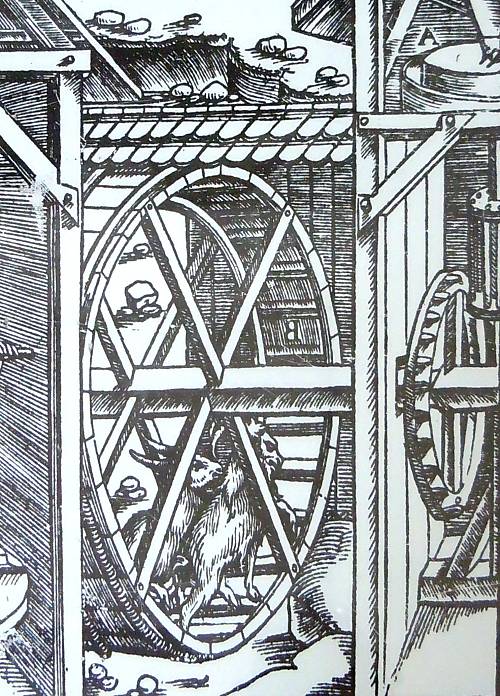 |
| Left: Picture of Goat Engine in Deutsch Museum, Munich: 1550
A two-goat-power engine allegedly driving an ore mill in 1550. Surely that would need more power than you could get out of a couple of goats? Note that the drive is geared up considerably to turn what appears to be a grind-stone at top right, which would appear to make the available torque even more inadequate.
Author's photograph June 2011
|
DONKEY POWER
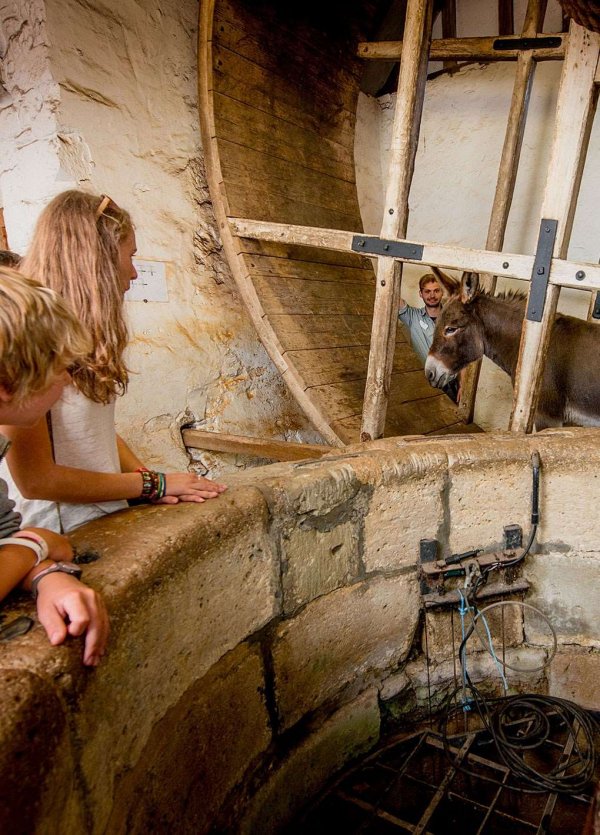 |
| Left: Donkey Engine at Carisbrooke Castle: 1550
The well house at Carisbrooke Castle on the Isle of Wight, was once the main water supply- under siege it was the only water supply. This well in the inner bailey courtyard was built after the previous one in the keep ran dry in 1136, leading to the castle's surrender. The new well is 49 metres deep and 1.6 metres in diameter; the upper part is lined with stone and the lower part was cut down through the chalk. The water at the bottom is currently some 12 metres deep.
It takes a good deal of work to lift buckets of water from a well 49 metres deep. By 1292 a treadwheel had been put in place to raise buckets. The well house and treadwheel visible today were built by Sir George Carey in approximately 1587, at the same time as a large underground water cistern west of the Constable's Lodging.
Built in the 1580s, a huge oak wheel would be turned to draw a bucket down to the water and back up again. To lift one bucket, the occupant of the wheel must walk 260m, a job that may have originally been performed by prisoners in the castle. Since at least 1696 (as reported by Celia Fiennes) however, the treadwheel has been worked by a team of donkeys, as it is today to impress tourists.
|
PIG HAULAGE
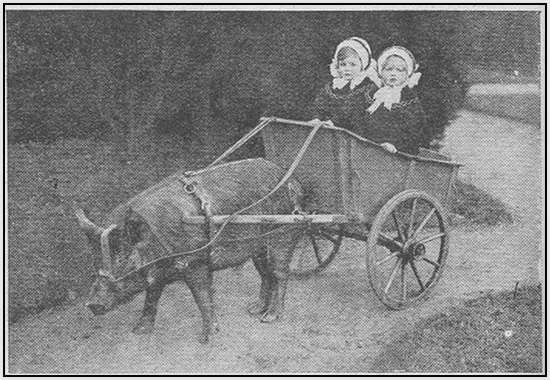 |
| Left: Pig pulling small cart
The load looks well within the capacity of the large pig.
|
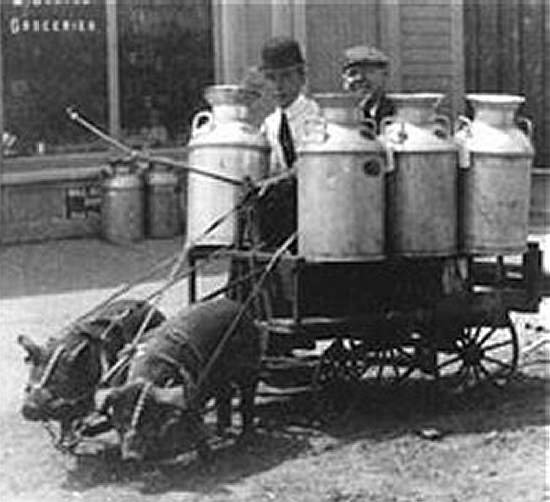 |
| Left: Two pigs pulling small milk cart
Two rather small pigs apparently have adequate pig-power to haul around milk churns.
Unfortunately the word on the shop window cannot be read, but to me it has a sort of French look about it.
|
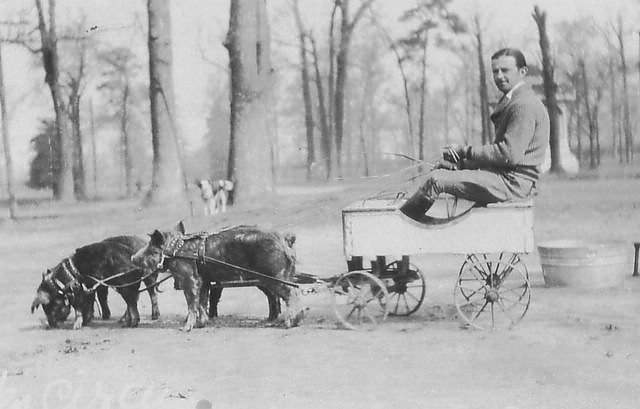 |
| Left: Four pigs in hand
This looks like a more than adequate power-plant to pull the chap on the cart.
|
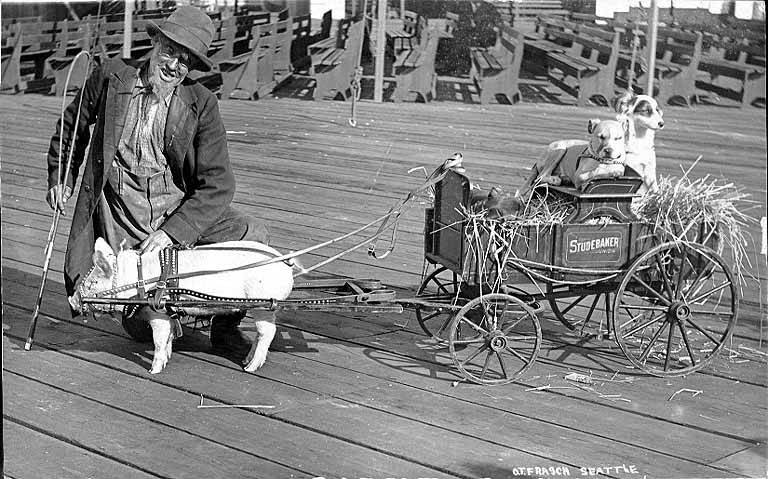 |
| Two dogs being pulled by a pig
Luna Park was an amusement park that operated from 1907 until 1913
Location: Luna Park, Seattle, Washington; August 1909
|
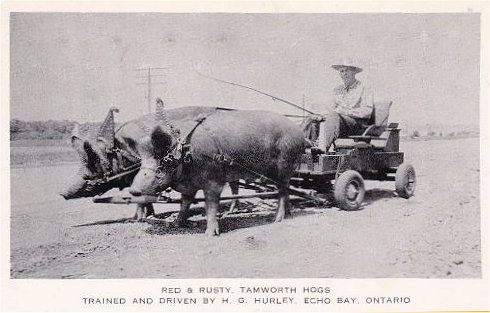 |
| Pig-drawn cart at Echo Bay, Ontario, Canada: 1950-60s
Two rather larger pigs, called Red and Rusty.
|
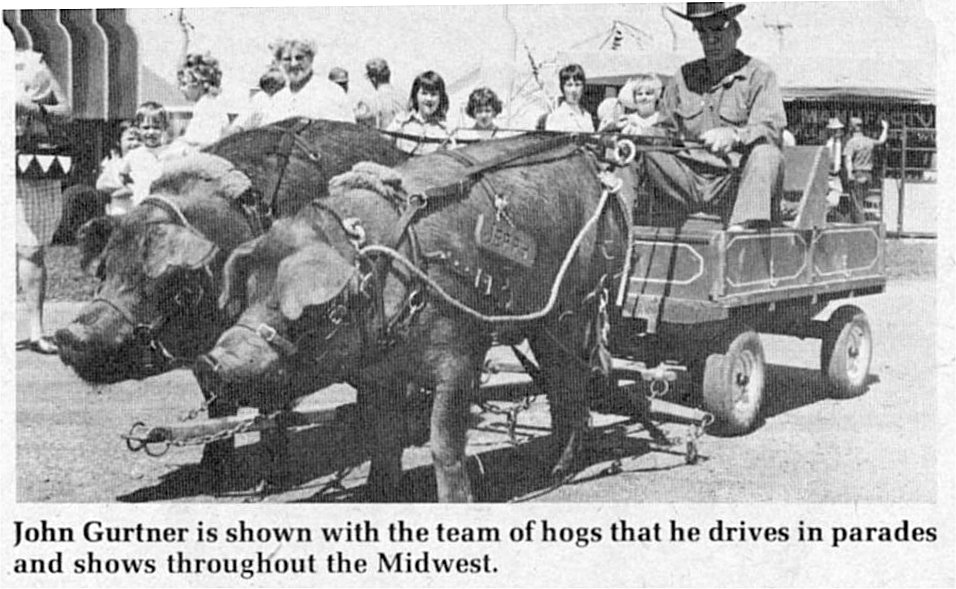 |
| John Gurtner and his hog-team: 1980
John Gurtner and his wife Talitha exhibit their hog-team at country shows and parades. Some seriously big pigs there. The nearer pig is apparently called 'Jepp' according to the little notice attached to its harness.
More details at farmshow.com, dated 1980.
|
LION HAULAGE
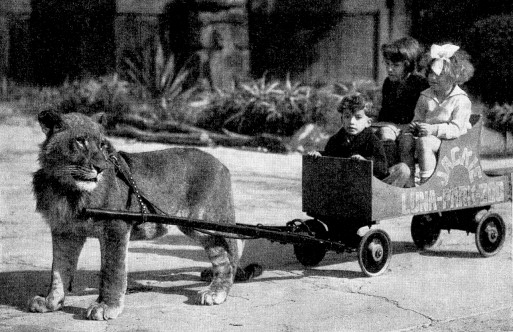 |
| Left: Lion haulage in America: circa 1930
A half-grown lion cub pulls a cart full of children at Luna Park Zoo in America circa 1930. Attempting this with a full-grown lion would be inadvisable.
|
OTHER UNUSUAL DRAUGHT ANIMALS
The usual draught animals are horses, mules, donkies, oxen, reindeer, elephants, camels, and llamas, depending of course in which part of the world you are in.
An unusual way of using horse-power was to put them on a treadmill and thus turn a boat propellor. See the Experiment, a horse-powered ferry-boat.
But now for unusual draught animals. Firstly, the ostrich:
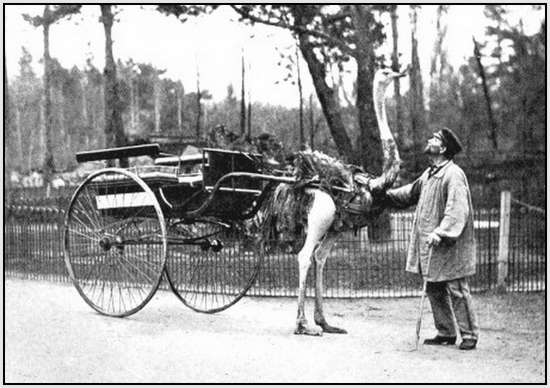 |
| Left: An ostrich pulling a small carriage
From the costume of the attendant, this would seem to be in France or Belgium, round about the 1900's.
Actually, this is not that unusual. A Google image search on "ostrich cart" brings up dozens of different pictures.
|
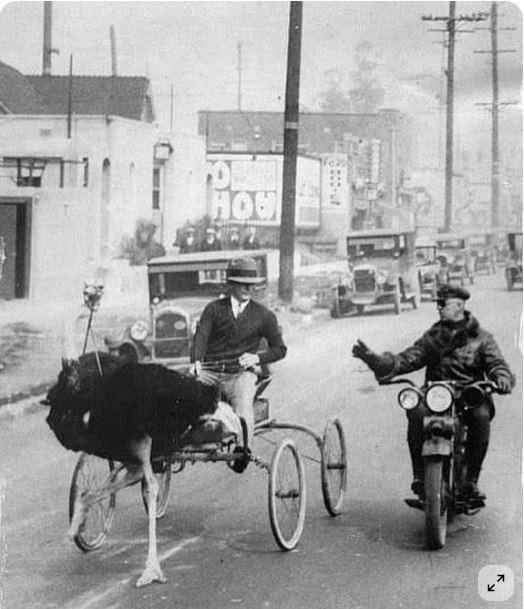 |
| Left: Another ostrich pulling a small carriage: 1920s?
Another ostrich-powered vehicle, with four wheels this time. This scene has an American feel. Is that a motorcycle cop on the right??
|
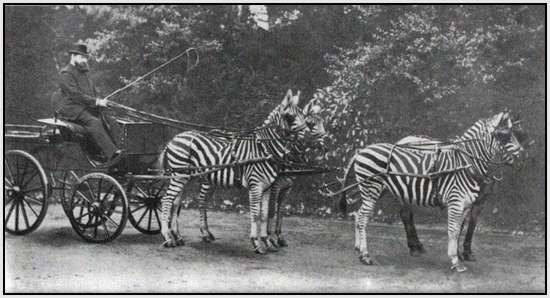 |
| Left: Driving zebras four-in-hand
This may not impress you greatly; much the same as horses, I hear you say.
No. Zebras are much harder to train than horses; they are very prone to bite and kick, and panic easily.
The picture shows a team of zebras were seen pulling a coach through London. They were trained by a Mr Hardy, who was a noted horserider & trainer, for a bet made by Leopold de Rothschild, who knew of Hardy's abilities, and said that he could train any animal resembling a horse. After two years of hard work training the zebras, At 6 o'clock one morning, four zebras were seen pulling a coach through the streets of London for the first time.
|
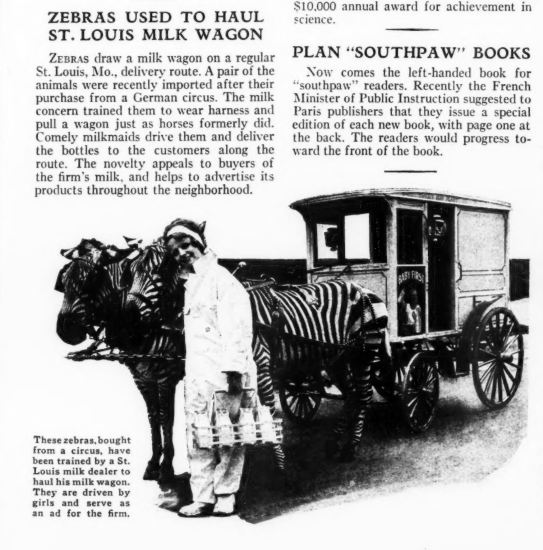 |
| Left: Milk float drawn by two zebras: 1931
Whether the fact that the zebras had been bought from a circus facilitated their training is currently unknown.
Source: Popular Science Monthly for 1931-07: Vol 119 Iss 1
|
Zebra-donkey and zebra-pony hybrids were also used for haulage.
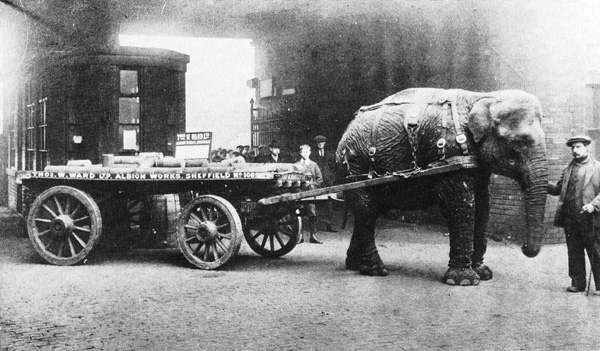 |
| Left: Haulage by elephant: 1916
Lizzie the elephant came to Sheffield as part of William Sedgwick’s menagerie; which took winter quarters there during WW1. Lizzie was hired by scrapdealer Thomas Ward for the haulage of scrap metal, after his horses were requisitioned for the war effort. She became a well-known sight in the city, pulling a load that would have required three horses.
There is more information on Lizzie here.
Source: Sheffield Local Studies
|
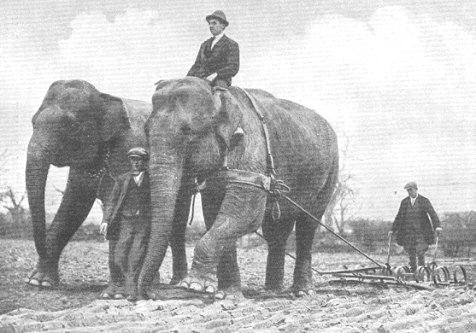 |
| Left: Ploughing by elephant: 1929
Two circus elephants pulling a plough land in Surrey, England in 1929, instead of heavy draught horses. In the winter, when the circus was not touring, animals such as elephants were hired out to earn money and to keep them fit. Elephants might also be used to haul felled trees.
|
If these drawings and stories have inspired you to create your own dog or goat-power device, try these patent and investment specialists:


